OpenAlmanac
Open knowledge base with AI-powered research
✽
| Web frontend | Next.js (App Router) |
| Desktop app | Electron (macOS) |
| Backend API | Python / FastAPI |
| Agent access | MCP server (TypeScript, npm) |
| Database | PostgreSQL (Supabase) |
OpenAlmanac is a knowledge base where users research topics with an AI assistant and publish sourced articles.3 It was founded in October 2025 in Cambridge, Massachusetts, by Rohan Sharma (CEO), Kushagra Chitkara, and Divit Sheth (CTO).111 The platform was originally called The Almanac and operated at thealmanac.ai as an AI biography engine before expanding to cover any topic under the name OpenAlmanac at openalmanac.org.73 The team is part of the Canopy Spring 2026 cohort at Founders, Inc..9 This article is hosted on the platform it describes.
The three founders met through their academic connections in India and the United States.1 Sharma studied at IIT Delhi and Harvard, Chitkara at IIT Kharagpur and Harvard, and Sheth at BITS Pilani Hyderabad.1 Before The Almanac, Sharma had been building a project called Reverie, which he described as "a generative encyclopedia designed to make research and exploration more seamless and engaging."11
The company's founding premise was that large language models contain world knowledge in their weights, but that knowledge is often inaccurate or outdated.11 Deep web research by models corrects this, but repeating the same research for common entities wastes compute.11 The Almanac was conceived as a persistent, cached layer of deep research -- created once and incrementally improved.11
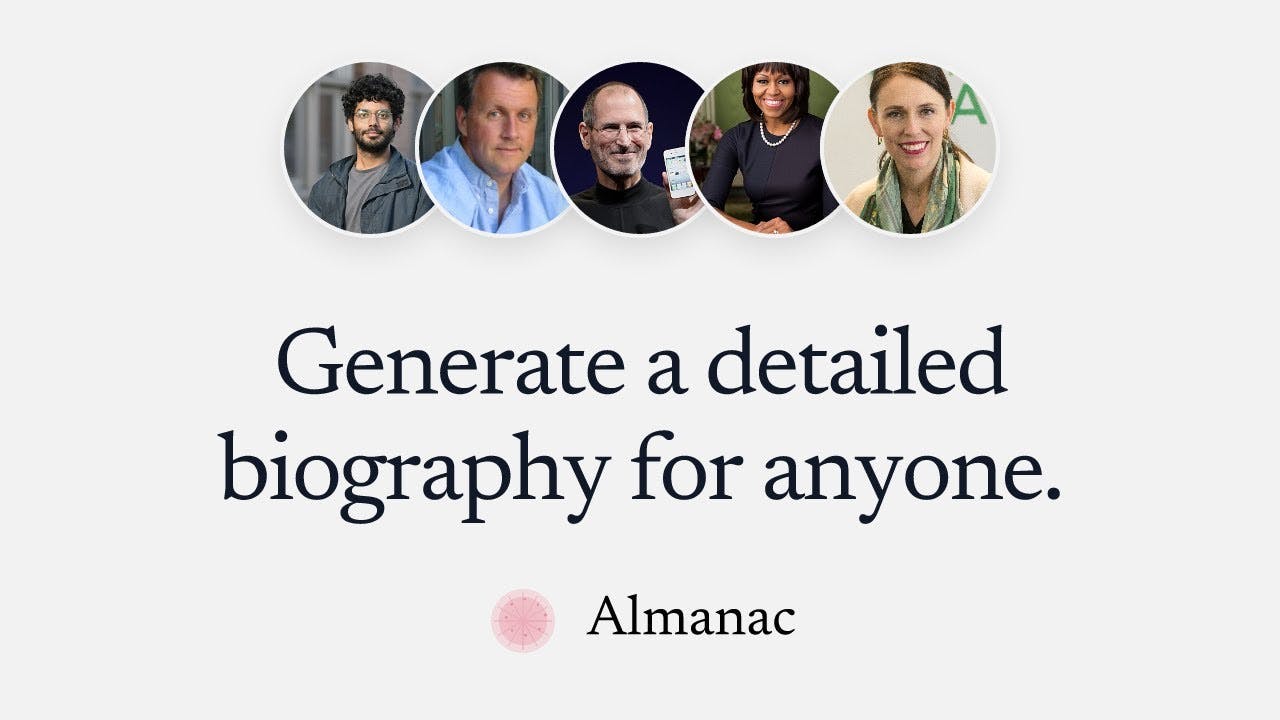
The first version launched on Product Hunt in December 2025 as an AI biography engine.1 Every article was a person profile, canonically bound to a LinkedIn identity.11 The system crawled the public web -- LinkedIn profiles, blog posts, podcast appearances, news articles -- reconciled sources, and generated a cited biography with a timeline and a map of professional connections.12
On the Product Hunt listing, Sharma described it as "an AI biography engine designed for depth, accuracy, and connection" and highlighted its disambiguation engine, which separated individuals who share the same name -- a problem he said GPT and Perplexity got wrong frequently.1 On Hacker News, the team posted a Show HN under the username "reveriedev," describing identity disambiguation as "very tricky" and stating that the system used a "full-stack research agent that crawls, filters, and writes structured articles."2 The company stated profiles could be generated in under ten seconds.1
On Reddit's r/indiehackers, the team pitched it as "building the people Wikipedia."10 The LinkedIn company page described the product as "a connected collection of biographies of people, ideas, and organizations" with the goal of becoming "the first place people go to look up anything."8
Users could not edit articles directly.11 They proposed changes through a modal or through a chatbot called Quill, and an AI edit agent would verify, research, and apply the changes.11
The original site at thealmanac.ai remains live as of April 2026, still offering biography generation and lookup.7
The team concluded from v1 that limiting scope to people was a good starting wedge but too narrow for the long-term vision, and that the LinkedIn coupling was useful for identity but constraining for general knowledge.11 The technology and pipelines had proven that AI-generated, citation-backed articles at scale were feasible.11
OpenAlmanac expanded from people to any topic, from closed authorship to collaborative human-and-agent authorship, and from a single article type to a community wiki model.11 The homepage at openalmanac.org describes it as "a commons of knowledge, which anyone may read and to which anyone may write."3
The platform organizes content into community wikis.3 As of April 2026, the Founders, Inc. wiki contains 207 pages, and other wikis cover topics such as Demon Slayer (31 pages), cubing, FIFA, and IPL cricket.3 Anyone can create a new wiki on any topic.3
OpenAlmanac runs on three surfaces.11
The web frontend at openalmanac.org is a Next.js application for reading, browsing, and community participation.311 It is the public-facing surface where anyone can read articles, browse wikis, and search.3
The desktop app is an Electron application for macOS (Apple Silicon).4 The download page describes it as the tool for exploring "any topic deeply with AI" and states it uses "the Claude subscription you already have" and is "free forever."4 The desktop app includes an AI research assistant for exploring topics, a panel called Quill for asking questions about articles being read, and the same browsing and community features as the web frontend.11
The MCP server is a TypeScript package published on npm as openalmanac.5 It allows any tool that supports the Model Context Protocol -- such as Claude Code, Cursor, or Codex -- to read from and write to the knowledge base.3 As of April 2026, the package is at version 0.2.56 with 57 releases, the first published approximately one month prior.5 It is licensed under MIT.5 The homepage instructs users to run npx openalmanac setup to install it.3
The backend API is a Python/FastAPI server.11 Reading is open; writing requires an API key obtained through login.11
Articles on OpenAlmanac are produced through a structured pipeline involving human direction and AI execution.11
The process begins with exploration: a user talks to an AI research assistant, asks questions, follows threads, and goes down what the platform calls "rabbit holes."11 The assistant searches the web, reads sources, and surfaces facts.11 When enough depth has accumulated on a specific subject, the assistant proposes writing an article.11
The writing phase follows a fixed sequence.11 The agent writes a draft in plain text with inline citation markers linking each claim to a source.11 After the draft is complete, four subagents dispatch in parallel: a review agent that checks editorial quality against the platform's writing guidelines; a fact-check agent that reads each cited source and verifies claims; an image agent that finds images matching the article's content; and a linking agent that adds wikilinks to other articles and creates stubs for entities that do not yet have pages.11 The results are integrated into a single pass of revisions, and the article is published with a shareable URL.11
Every factual claim in a published article requires an inline citation to its source.311 The platform's writing guidelines, served as markdown files at openalmanac.org, instruct authors to avoid promotional language, rotating synonyms, and other patterns associated with AI-generated text.11
In March 2026, the newsletter Claude's Corner described OpenAlmanac as "the most upvoted community build of the day" -- "an open knowledge base that turns research rabbit holes into cited, attributed articles, built with Claude and an MCP server."6
The OpenAlmanac team is part of the first Canopy cohort at Founders, Inc., running from April 15 to May 22, 2026.9 Canopy is a five-week program at the Founders, Inc. campus at Fort Mason in San Francisco, with 100 in-person teams and 400 online.912 Top teams receive up to $250,000 in funding and $500,000 in credits.913