GCast
Mobile game casting to big screens
✽
GCast is a mobile application that streams a phone's game display to televisions and other large screens in real time, letting the phone continue to serve as the controller. The product is built on the premise that mobile games deserve the same big-screen treatment as console and PC titles, without requiring dedicated hardware beyond a WiFi network. The game runs on the device; only the rendered frame stream is transmitted to the display. 2
The company was founded in 2025 by Jules Testard and Filippo Scognamiglio, who previously worked together at Jam.gg, a Y Combinator-backed cloud gaming platform that grew to 8 million users. 1 GCast participated in the inaugural Canopy Spring 2026 cohort at Founders, Inc., Fort Mason, San Francisco. 12
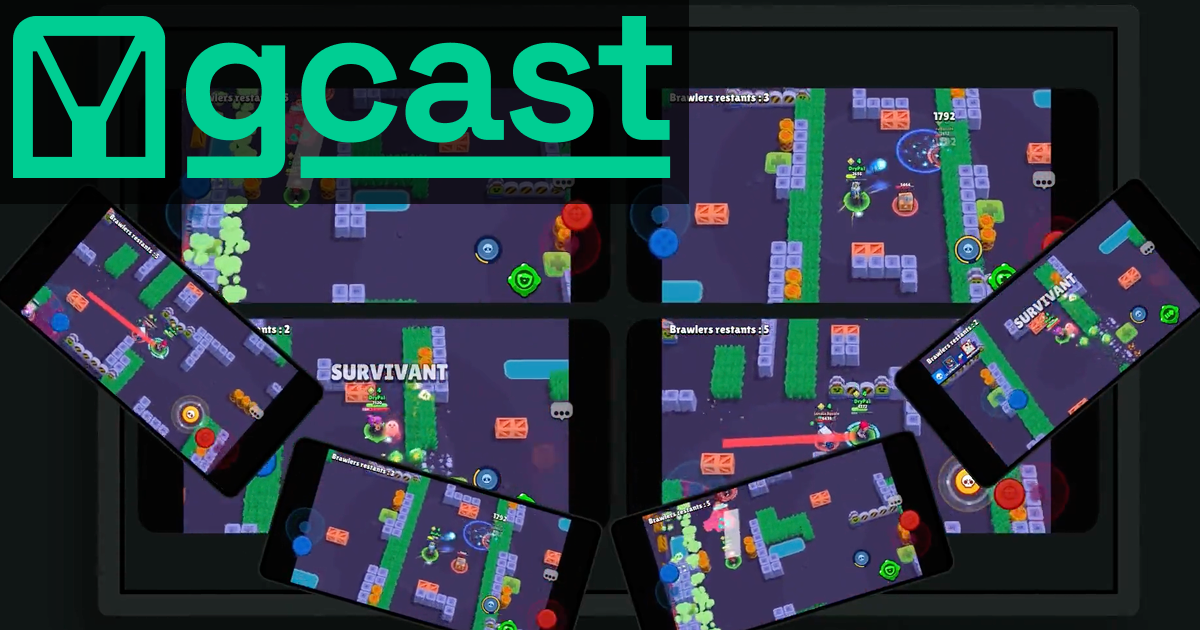
GCast works by capturing the rendered output of whatever game is running on the user's phone and streaming it to a receiver — a smart TV, a streaming dongle, or a desktop browser tab. The game itself never leaves the device: no processing is offloaded to a cloud server, and no special hardware beyond a standard WiFi connection is required. 2 GCast describes the architecture explicitly as "not cloud gaming," distinguishing it from services that run game logic on remote servers. 2
The app reports a display latency of 16 milliseconds from frame capture to screen render on local WiFi. 2 The underlying transport layer uses WebRTC, the open real-time communication protocol originally developed for browser-based video calling, which also enables casting sessions to be established over the internet rather than limited to the local network. 3
GCast can cast to the following display types: 2
GCast includes a couch-multiplayer mode in which additional players can join the same session from their own phones, each operating as a separate controller while the shared game view displays on the television. 2 Private rooms are created with short join codes and support custom nicknames and pixel-art avatars. 3
A companion-screens feature is listed as forthcoming: secondary devices would display supplementary information such as maps, in-game stats, or dashboards alongside the main cast view. 2
The product is designed to work with any mobile game without requiring cooperation from the game publisher, capturing the screen at the OS level rather than integrating via a game SDK. GCast's marketing materials cite Roblox, Subway Surfers, and Brawl Stars as representative titles. 2
GCast launched in public beta in 2026, available for free on the App Store and Google Play. The company states that basic casting will remain free after beta ends, while a paid tier will unlock unlimited sessions and additional features. 2 All gameplay data remains on the user's device; GCast's privacy disclosure states no user data is collected or shared. 3 4
The iOS app requires iOS 17.0 or later and is 78.6 MB. Version 26.4.16, released in April 2026, added IPv6 network support. 3
Jules Testard is a software engineer who co-founded Jam.gg (originally named Piepacker) with Benjamin Devienne in 2020. Piepacker was accepted into Y Combinator's Summer 2020 batch and grew into a web-based multiplayer platform offering more than 80 licensed retro and party games. 5 Testard served as CTO, and by his own account contributed 30 percent of the codebase over five years and negotiated $1.3 million in B2B contracts following a strategic pivot. 1 The platform raised approximately $15 million in total funding, including a $12 million Series A led by LEGO Ventures in October 2021, with participation from Makers Fund and V13 Invest — a vehicle affiliated with FDJ and Serena. 6 The platform ultimately reached 8 million registered users before winding down. 1
Before Jam.gg, Testard worked on the metadata crawler backend for AWS Glue, contributed to Docker Enterprise Edition's Kubernetes integration, and built high-frequency ad trading systems at MadHive. 1 He holds a B.Sc. in Computer Science from McGill University and an M.Sc. from UC San Diego. 1
Filippo Scognamiglio is an Android software engineer who created two widely adopted open-source projects — Lemuroid and Cool-Retro-Term — before co-founding GCast.
Lemuroid is a multi-system emulator for Android that Scognamiglio built on the Libretro framework and released as open source. It supports eleven platforms: NES, SNES, Game Boy, Game Boy Color, Game Boy Advance, Sega Master System, Sega Genesis, Nintendo 64, Nintendo DS, PlayStation Portable, and Arcade (via FinalBurn Neo). 9 The emulator provides automatic ROM detection via directory scanning, cover art downloads, customizable touch and gamepad controls, and visual shader filters including CRT and LCD screen simulations. 9 The project has accumulated more than 223,000 downloads on Uptodown alone and is distributed through Google Play, F-Droid, and GitHub. 11 10
Cool-Retro-Term is a terminal emulator Scognamiglio authored that mimics the visual appearance of vintage cathode-ray tube monitors, including scanlines, screen curvature, and glow effects. 8 The project has 25,000 GitHub stars and ships with most major Linux distributions. 1 Version 1.2.0 (January 2022) added sub-pixel rasterization and a blinking cursor option. 8
Scognamiglio also developed CUT (Cheap Upscaling Triangulation), a family of pixel-art upscaling algorithms designed to enhance retro game visuals on modern high-resolution displays without blurring pixel edges. 8
At Jam.gg, Scognamiglio served as Director of Engineering, focusing on cloud gaming platform architecture and mobile connection optimization — work directly applicable to GCast's low-latency casting stack. 1 Before Jam.gg, he led engineering at Moneyfarm, a UK-based digital wealth management service. 1 He holds a Master's degree in Computer Science and Multimedia from the University of Pavia. 1
Jam.gg — originally launched in March 2020 under the name Piepacker — was a web-based platform that let users play multiplayer retro and party games in a shared browser session without downloading software. Its technical proposition was a patented streaming approach that reduced bandwidth requirements compared to standard video game streaming, making it accessible on ordinary home broadband. 6 Licensed game partners included Codemasters, Interplay, Team17, and Data East. The company had close to half a million beta users at the time of its Series A in October 2021. 6 The platform rebranded from Piepacker to Jam.gg in 2022 as it expanded its library onto mobile, and reached 8 million registered users before winding down. 7 1
After a strategic pivot in 2023, the entity split into Jam and Onibi as separately operating companies, with Y Combinator on both cap tables. 5
Testard's and Scognamiglio's tenure at Jam.gg gave both founders hands-on experience with the specific engineering challenges — frame capture, low-latency transport, and mobile network optimization — that GCast addresses in a different architectural direction: instead of streaming games from a server to a phone, GCast streams from a phone to a screen.
GCast joined the inaugural Canopy Spring 2026 cohort at Founders, Inc., a venture studio and campus at Fort Mason in San Francisco. The program ran from April 15 to May 22, 2026, selecting 100 on-site teams and 400 online teams from more than 6,500 applications. 12 GCast's participation placed it alongside other early-stage consumer and developer-tools companies building at Fort Mason during the five-week sprint.