CFOP Method
Speedcubing method for the 3x3x3 Rubik's Cube
✽
| F2L | 0 (intuitive) to 41 |
| OLL | 57 |
| PLL | 21 |
| 2-look minimum | 16 |
The CFOP method is the most widely used speedsolving method for the 3x3x3 Rubik's Cube.1 The name is an acronym for its four steps: Cross, F2L (First Two Layers), OLL (Orientation of the Last Layer), and PLL (Permutation of the Last Layer). Developed between 1978 and 1981 by several independent contributors, the method was popularized by Czech speedcuber Jessica Fridrich, who published a complete description with algorithm lists on her website in 1997.2 Full CFOP requires memorizing 78 algorithms (57 OLL and 21 PLL), though adding the 41 algorithmic F2L cases brings the total to 119.3
CFOP and its variants have been used by the vast majority of top speedcubers since around 2000, including Feliks Zemdegs and Max Park.1 Nearly all 3x3 world records from 2003 onward were set using CFOP, though recent records have been set by solvers incorporating ZBLL extensions.13
CFOP was not invented by a single person.
The cross — solving four bottom-layer edges to their matching center — first appeared in print in Donald Taylor's 1978 paper The Group of a Coloured Cube.2 David Singmaster's 1980 publication Notes on Rubik's 'Magic Cube' further spread the cross as a starting step for layer-by-layer methods.1
The technique of pairing a first-layer corner with its matching second-layer edge and inserting both simultaneously — the core of F2L — was first published in 1979 by John Conway, David Benson, and David Seal in two papers: Solving the Hungarian Cube and Solving the Hungarian Cube in Less Than 100 Moves.2 These publications included complete algorithm tables for all possible F2L cases. The idea appeared again independently in a September 1981 issue of Cubism for Fun, credited to Dutch mathematician René Schoof.2 Frans Schiereck published the technique in December 1981 in De Hongaarse Kubus Voor Doordraaiers, and Guus Razoux Schultz published a complete F2L algorithm table in Cubism for Fun in June 1984.2
The last-layer approach of orienting all pieces first (OLL) and then permuting them (PLL) was developed independently by two groups starting in 1981: Kurt Dockhorn, Hans Dockhorn, and Anneke Treep in the Netherlands, and Jessica Fridrich and Mirek Goljan in the Czech Republic.2 The Dockhorns and Treep first published their OLL/PLL algorithms in 1981 in De Hongaarse Kubus Voor Gevorderden.2 Fridrich published her algorithms in a 1982 issue of the Czech magazine Mladý Svět and later stated that she developed most of the algorithms between the summer of 1981 and the spring of 1983, with Goljan contributing additional moves.25
The 1979 Conway/Benson/Seal papers had already included complete algorithms for PLL-then-OLL (the reverse order), making them arguably the first complete cross-based method with a two-algorithm last layer, though this approach did not gain traction at the time.2
Fridrich switched from a layer-by-layer method to F2L in 1982 after learning the pairing idea from Guus Razoux Schultz at the 1982 World Rubik's Cube Championship.1 She launched a website with complete algorithm lists in January 1997, following discussions on the Cube Lovers mailing list.2
During the speedcubing revival of the late 1990s and early 2000s, Fridrich's website was one of the few comprehensive English-language resources available. Many new cubers learned the method there and began calling it the "Fridrich Method."3 Several prominent cubers, including Ron van Bruchem, co-founder of the World Cube Association, have disputed this name, arguing that it obscures the contributions of Conway, Benson, Seal, the Dockhorns, Treep, Schoof, and others.3 The descriptive acronym "CFOP" became more common from around 2008 onward, though both names remain in use.3

The solver begins by placing four edge pieces of a single color onto their matching center, forming a plus-sign shape. Most CFOP cubers solve the cross on the bottom face to avoid a cube rotation before F2L.3 The cross can always be solved in 8 moves or fewer.1
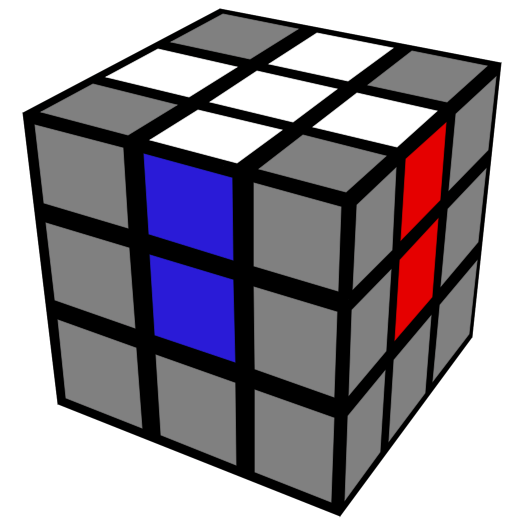
During the 15-second inspection period allowed at WCA competitions, solvers plan their entire cross solution. Advanced solvers also plan their first F2L pair during inspection, a technique known as "cross+1."1 An XCross solves the cross and first F2L pair in a single move sequence, a technique proposed by Chris Hardwick in 2003–2004.2
More advanced cubers practice color neutrality, meaning they can start the cross on any of the six faces, choosing whichever color yields the easiest solution for a given scramble.1
After the cross, four "slots" remain around the bottom two layers. Each slot holds a corner-edge pair: a bottom-layer corner and the adjacent middle-layer edge that share colors. The solver pairs each corner with its matching edge in the upper layer and inserts them together into the correct slot.3
F2L can be solved in two ways. Intuitive F2L uses basic pairing rules — if the corner and edge are separated, bring them together; if they are paired, insert them — requiring no memorized algorithms.1 Algorithmic F2L uses memorized sequences for all 41 standard cases, plus many additional cases for advanced solvers who want to avoid cube rotations.1
Because F2L is the longest step, top solvers use a technique called lookahead: while solving one pair, they track the pieces of the next pair so they can transition continuously without pausing.1
OLL makes the top face a single color by orienting all last-layer pieces so their top-face sticker points upward, without regard to their lateral position. There are 57 distinct OLL cases (excluding the already-solved state), each requiring a specific algorithm.3

Beginners typically learn two-look OLL, which splits the step into edge orientation (3 cases to form a top cross) and corner orientation (7 cases), totaling 10 algorithms.1 It is even possible to solve all OLL cases with just two algorithms — the Line algorithm and Sune — by repeating them in the correct orientations, though this creates a slow "6-look OLL" practical only as a stepping stone.1
The OLL numbering system was created by Fridrich on her website. Her original system did not include mirror cases; the Japanese speedcubing community later expanded the numbering to cover all 57 cases.2
PLL places all last-layer pieces into their correct positions while maintaining their orientation. There are 21 PLL cases, each named with a letter (A-perm, T-perm, H-perm, etc.).1 The letter-naming system was created by Mirek Goljan and published on Fridrich's website.2
Two-look PLL solves corners first, then edges, using 6 of the 21 algorithms: typically the T-perm and Y-perm for corners, and the U-perm (clockwise and counterclockwise), H-perm, and Z-perm for edges.1
A PLL skip — where the last layer is already correctly permuted after OLL — occurs in roughly 1 in 72 solves. An OLL skip occurs about 1 in 216 solves. A full last-layer skip, where both OLL and PLL are already solved after F2L, happens approximately once in 15,552 solves.1
A common progression for learning CFOP:
Most competitive cubers who average under 20 seconds know full PLL and at least two-look OLL. Sub-10 solvers almost universally know full OLL and PLL.6
Several algorithm sets can be layered on top of standard CFOP to reduce move count or skip steps.
COLL (Corners of the Last Layer) solves last-layer corners while preserving edge orientation during OLL, forcing an easier PLL case. It adds 42 algorithms.1
Winter Variation applies when the last F2L corner-edge pair is already connected in the upper layer and the last-layer edges are already oriented. It orients all last-layer corners during insertion of the final pair, skipping the OLL step entirely.1
ZBLS (Zborowski-Bruchem Last Slot) solves the last F2L pair while orienting all last-layer edges, guaranteeing a top-face cross before the last layer step. It requires 125 algorithms.1 Combined with ZBLL (493 algorithms to solve the entire last layer in one step when edges are already oriented), this forms the ZB method — a CFOP variant that replaces OLL and PLL with a single last-layer algorithm.1
As of 2026, top solvers including Xuanyi Geng and Tymon Kolasinski have incorporated ZBLL into their solves, selectively using ZB-style finishes alongside standard CFOP.1 The 3x3 single world record of 2.76 seconds, set by Teodor Zajder in February 2026, used an XXXCross with a ZBLL finish.1
CFOP has more published algorithm guides and tutorials than any other 3x3 method, a consequence of two decades as the dominant competition method.3 Its average move count of roughly 57.5 in half-turn metric is higher than the Roux method and slightly higher than ZZ.3
CFOP requires cube rotations during F2L, unlike Roux and ZZ which largely avoid them.3 The method depends on the 15-second inspection period for cross planning, which is a disadvantage during big-cube solves where no dedicated inspection is available for the 3x3 reduction stage.3