Mario Zechner
Austrian open-source programmer, creator of libGDX and pi
✽

Mario Zechner is an Austrian programmer based in Graz, best known for creating libGDX, a free, open-source cross-platform game development framework written in Java, and pi, a minimal open-source coding agent released in 2025. He was also a core member of the RoboVM team and wrote Beginning Android Games (Apress), a book on Android game development.15
In mid-2009, Zechner started building a framework called AFX (Android Effects) to write games for Android.2 Finding that the iteration cycle between desktop development and Android deployment was too slow, he modified AFX to also run on the desktop, which became the foundation of what later became libGDX.2 On March 6, 2010, Zechner open-sourced the project on Google Code under the GNU Lesser General Public License.32

In July 2010, the license changed to Apache License 2.0 after users pointed out that the LGPL created complications for Android development.3 Christoph Widulle became the first external contributor in April 2010.2 Nathan Sweet joined in October 2010 and eventually became a co-copyright holder on the project.3
libGDX expanded to support Windows, Linux, macOS, Android, iOS, and HTML5/WebGL.3 In 2012, Zechner wrote a GWT-based HTML5 backend inspired by Google's PlayN framework, allowing libGDX games to run in any browser with WebGL support.2 iOS support arrived the same year using MonoTouch, later replaced by a RoboVM backend.2 Version 1.0 shipped on April 20, 2014, more than four years after the project's first commit.3 That year libGDX won a Duke's Choice Award from Oracle, recognized for its focus on platform-independence; Zechner described the project's goal as fulfilling the "write once, run anywhere" promise of Java specifically for game development.3
Notable users include Niantic, whose game Ingress was built with libGDX (Pokémon Go was not), and the developers of Slay the Spire.1 Spine, a commercial skeletal animation tool widely used in game development, is also built on top of libGDX.1 By early 2016, more than 3,000 games had been submitted to the libGDX showcase gallery.3 Zechner stepped back from day-to-day maintenance in 2016, handing the project to a team of community contributors; version 1.13.5 was released in May 2025.23
RoboVM was an ahead-of-time compiler and runtime for JVM code on iOS, created by Niklas Therning and Henric Müller.1 Therning wrote a RoboVM backend for libGDX in early 2013, integrated into the project by September.3 Therning and Müller subsequently built a company around RoboVM and brought Zechner on board to create its first commercial product: a debugger.1 The team grew by five additional people and reached near feature parity with Xamarin, including an IntelliJ IDEA-based IDE.1 The open-source RoboVM core was the foundation; the debugger and Xcode storyboard integration were the commercial layer.1
Xamarin acquired RoboVM and close-sourced the open-source core; Microsoft then acquired Xamarin and shut down the project entirely.1 Within days of the closure, libGDX contributors forked the old RoboVM repository. That fork, now called MobiVM, restored full feature parity within months and still powers libGDX on iOS.1
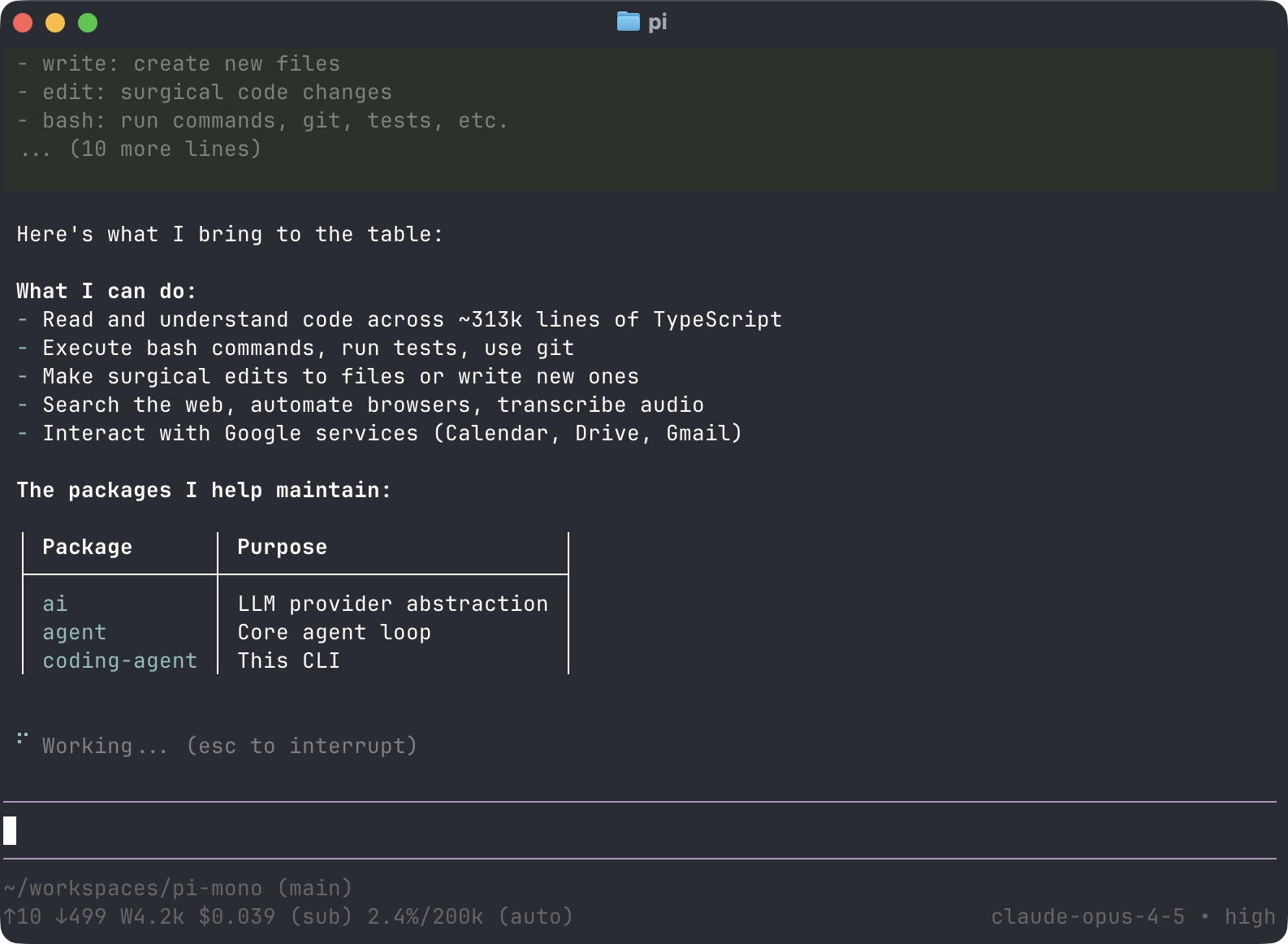
In November 2025, Zechner released pi, a coding agent harness he built after years of using existing tools including Claude Code and Cursor.4 His stated reasons were frustration with tools that accumulated features he did not use and that changed their system prompts and toolsets between releases, disrupting established workflows, and a desire for full observability into every message, tool call, and token.4
pi is built from four packages: pi-ai, a unified LLM API supporting Anthropic, OpenAI, Google, xAI, Groq, Cerebras, OpenRouter, and any OpenAI-compatible self-hosted endpoint; pi-agent-core, the agent loop handling tool execution and event streaming; pi-tui, a terminal UI framework with differential rendering; and pi-coding-agent, the CLI layer with session management and project context files.4 The design deliberately omits built-in task lists, plan mode, MCP support, sub-agents, and background bash execution.4 pi is MIT-licensed.6 By early 2026, the repository had accumulated more than 26,300 GitHub stars.7
Armin Ronacher, co-founder of Earendil and creator of Flask, wrote a public post in January 2026 praising pi's design after it was integrated into OpenClaw, a browser automation tool built by Peter Steinberger.8
In April 2025, Zechner and Ronacher separately obtained Claude Code subscriptions and began experimenting with AI coding agents.1 In May, the two along with Steinberger built VibeTunnel together at Steinberger's flat in Vienna.1 Zechner describes spectators giving their collaborative approach the name "the Vienna School of Agentic Coding"; he notes he is based in Graz, not Vienna.1
In April 2026, Zechner joined Earendil, an AI software company co-founded by Ronacher, taking pi as an Earendil product.1 Under the arrangement, pi remains MIT-licensed at its core, with future additions planned under Fair Source licensing — source-available with delayed open-source publication — and a proprietary tier for enterprise features.1 Zechner retains technical direction over pi, with Earendil handling business operations.1 The pi repository moved from badlogic/pi-mono to earendil-works/pi on GitHub.1